**Topic Map**
1. Introduction: Unraveling the “Waterproof” Claim
2. The Technical Reality: Why Rolex Avoids the Term “Waterproof”
3. The Oyster Case: The Foundation of Water Resistance
4. The Twinlock Crown: Rolex’s Double-Sealed Defense
5. Water Resistance Ratings Explained: 100 Meters (330 Feet)
6. Real-World Capabilities: Swimming, Snorkeling, and Diving
7. The Critical Distinction: Water Resistance vs. Waterproof
8. Common Threats to Your Datejust’s Water Seal
9. How to Maintain Your Datejust’s Water Resistance
10. Comparing the Datejust to Other Rolex Models (Submariner, Sea-Dweller)
11. The Vintage Datejust Exception: A Special Caution
12. Frequently Asked Questions (FAQs)
13. Conclusion: Reliable for Life, But Not Invincible
—
### 1. Introduction: Unraveling the “Waterproof” Claim
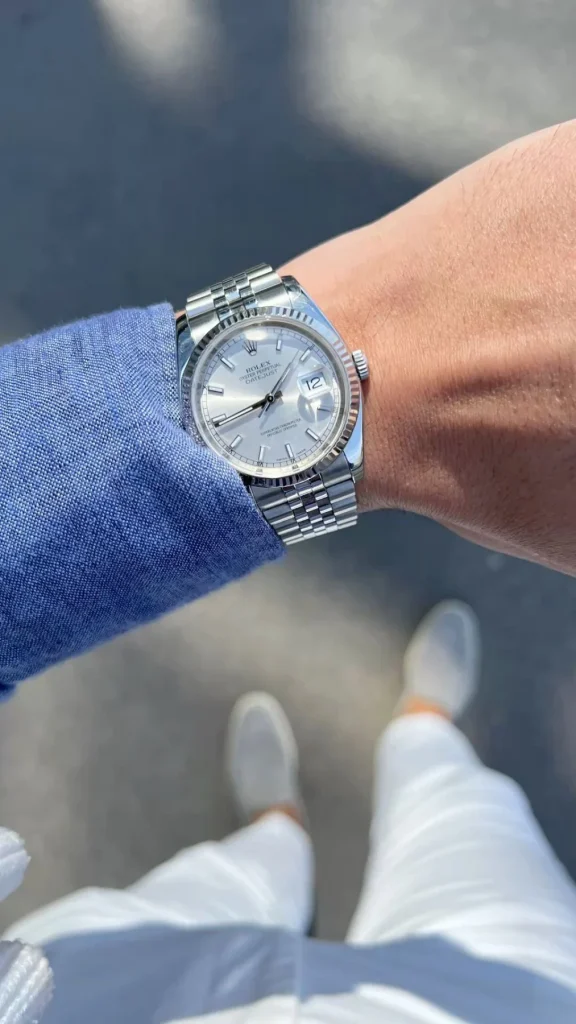
The Rolex Datejust is an icon. Since its launch in 1945, it has defined the classic wristwatch, seamlessly blending elegance with utility. A common question from owners and prospective buyers alike is: **Are Rolex Datejust watches waterproof?** The direct answer is that a modern Rolex Datejust is **highly water-resistant**, but no watch is truly “waterproof” in an absolute, permanent sense. Rolex itself has moved away from the term, yet the Datejust remains one of the most capable luxury timepieces for daily aquatic activities. This pillar page explores every angle of the Datejust’s relationship with water—from its engineering to its limits—so you can wear yours with confidence.
### 2. The Technical Reality: Why Rolex Avoids the Term “Waterproof”
Historically, Rolex used “Oyster, waterproof” in its advertising. However, from a scientific and legal standpoint, “waterproof” implies a permanent, unbreakable seal. Gaskets degrade, crowns loosen, and impacts occur. Today, Rolex (and the entire watch industry) uses the standard **“water-resistant”** to reflect that a watch’s ability to withstand water pressure is conditional on proper maintenance. Your Datejust is not a sealed diving bell; it is a precision machine whose seals require care.
### 3. The Oyster Case: The Foundation of Water Resistance
The Datejust is built around the legendary **Oyster case**, patented by Rolex in 1926. This hermetic case design uses a screw-down back and a screw-down winding crown, which thread tightly into the middle case. The case back is fluted to allow a tight seal against a special gasket. The crystal is also pressure-fitted. This entire architecture is what allows the watch to withstand the internal pressure created by water ingress. Without a properly sealed Oyster case, the Datejust would be vulnerable to moisture.
### 4. The Twinlock Crown: Rolex’s Double-Sealed Defense
A critical component is the **Twinlock winding crown**. The name refers to two separate, independent sealing zones inside the crown tube. One seal is inside the crown, and another is inside the case tube. When the crown is unscrewed (for manual winding or time-setting), the seals are relaxed. **You must screw the crown down fully against the case** to activate the water resistance. A loose crown is the single most common cause of water damage in a Rolex.
### 5. Water Resistance Ratings Explained: 100 Meters (330 Feet)
Every modern Rolex Datejust is rated to a **water resistance of 100 meters (330 feet)** . This is a pressure rating, not a depth rating. This means the watch has been tested to withstand static water pressure equivalent to 100 meters deep. For context:
– **30m (100ft):** Splash resistant, rain.
– **50m (165ft):** Shower, light swimming.
– **100m (330ft):** **Your Datejust’s rating** – Suitable for swimming, snorkeling, and even recreational surface water sports, but **not** for scuba diving or high-velocity water activities.
### 6. Real-World Capabilities: Swimming, Snorkeling, and Diving
– **Swimming (Pool, Lake, Ocean):** Yes. The Datejust is perfectly safe for lap swimming, casual ocean dips, and recreational swimming.
– **Snorkeling:** Yes. Surface-level snorkeling is within its 100m rating. However, repeated underwater movements and extreme arm motions (like diving for a shell) can increase pressure on the seals.
– **Scuba Diving:** **No.** The Datejust is not a dive watch. It lacks a unidirectional bezel for timing dives and, more critically, its engineering is optimized for 100m, not the 300m+ ratings of the Submariner or Sea-Dweller. Using it for scuba diving risks seal failure at depth.
### 7. The Critical Distinction: Water Resistance vs. Waterproof
– **Water Resistant:** A conditional state. It depends on gasket condition, crown tightness, and lack of impact. It degrades over time.
– **Waterproof:** Absolute, permanent, and unbreakable. **No mechanical wristwatch is truly waterproof.** Rolex’s use of the term was marketing genius, but today, we understand it’s a resistance that must be respected and maintained. Think of your Datejust as “water-resistant to 100 meters, provided you maintain it.”
### 8. Common Threats to Your Datejust’s Water Seal
Your Datejust can lose its water resistance due to:
– **Aged or dried-out gaskets:** The rubber seals inside the case back, crown, and crystal harden and crack over 3–5 years.
– **An unscrewed crown:** The most common cause. Even a half-turn loosened can allow moisture entry.
– **Impact or drops:** A hard knock can dislodge the crystal or warp the case, breaking the seal.
– **Extreme temperature changes:** Rapid shifts (e.g., hot shower after a cold pool) can create condensation inside the case.
– **Chlorine and saltwater:** These can accelerate gasket degradation. Always rinse your watch with fresh water after saltwater exposure.
### 9. How to Maintain Your Rolex Datejust’s Water Resistance
To keep your Datejust safe in water:
1. **Pressurize Test Annually:** A watchmaker can test your watch’s water resistance on a dry-pressure tester (no water inside). This is cheap and essential.
2. **Service Gaskets Every 5–10 Years:** During a full Rolex service, all gaskets are replaced. If you swim often, consider a more frequent interval.
3. **Always Screw Down the Crown:** Develop a habit of feeling the crown lock into its tight, closed position.
4. **Rinse After Saltwater/Chlorine:** Use lukewarm fresh water and a soft cloth to remove corrosive residues.
5. **Avoid High-Pressure Water:** No jet skis, water slides, or high-pressure hose sprays directly on the watch.
### 10. Comparing the Datejust to Other Rolex Models
| Model | Water Resistance | Crown Type | Intended Use |
| :— | :— | :— | :— |
| **Rolex Datejust** | **100m / 330ft** | Twinlock | Daily wear, swimming, snorkeling |
| Rolex Submariner | 300m / 1000ft | Triplock | Professional diving, heavy water sports |
| Rolex Sea-Dweller | 1220m / 4000ft | Triplock + Helium Valve | Saturation diving |
| Rolex Daytona | 100m / 330ft | Triplock | Racing, swimming |
| Rolex Explorer | 100m / 330ft | Twinlock | Land exploration, swimming |
**Key Insight:** The Datejust shares its 100m rating with the Explorer and Daytona, but lacks the Triplock crown (three sealing zones) found on dive watches. This is a design choice for a slimmer, more elegant profile.
### 11. The Vintage Datejust Exception: A Special Caution
**If you own a Datejust from before the 1980s, exercise extreme caution.** Vintage Oyster cases used different gasket materials (often natural rubber or cork) that have likely degraded decades ago. The general rule for vintage Rolex watches is **do not expose them to water** unless they have been completely restored and pressure-tested by a specialist. A vintage Datejust may look perfect, but its water resistance is almost certainly compromised.
### 12. Frequently Asked Questions (FAQs)
**Q: Can I shower with my Rolex Datejust?**
A: Technically, yes, but it’s discouraged. Hot water and steam can degrade gaskets faster and cause seals to expand/contract, potentially breaking the water-resistance barrier.
**Q: Can I wear my Datejust while scuba diving?**
A: No. It is not designed for depths beyond 100 meters, and it lacks the safety features (e.g., Triplock crown, helium escape valve) of a dive watch.
**Q: What happens if my Datejust gets wet inside?**
A: Stop wearing it immediately. Do not press any pushers or
Are Rolex Datejust Watches Waterproof? A Comprehensive Guide to Water Resistance
**Topic Map** 1. Introduction: Unraveling the “Waterproof” Claim 2. The Technical Reality: Why Rolex Avoids the Term “Waterproof” 3. The Oyster Case: The Foundation of Water Resistance 4. The Twinlock Crown: Rolex’s Double-Sealed Defense 5. Water Resistance Ratings Explained: 100 Meters (330 Feet) 6. Real-World Capabilities: Swimming, Snorkeling, and Diving 7. The Critical Distinction: Water […]
admin ·