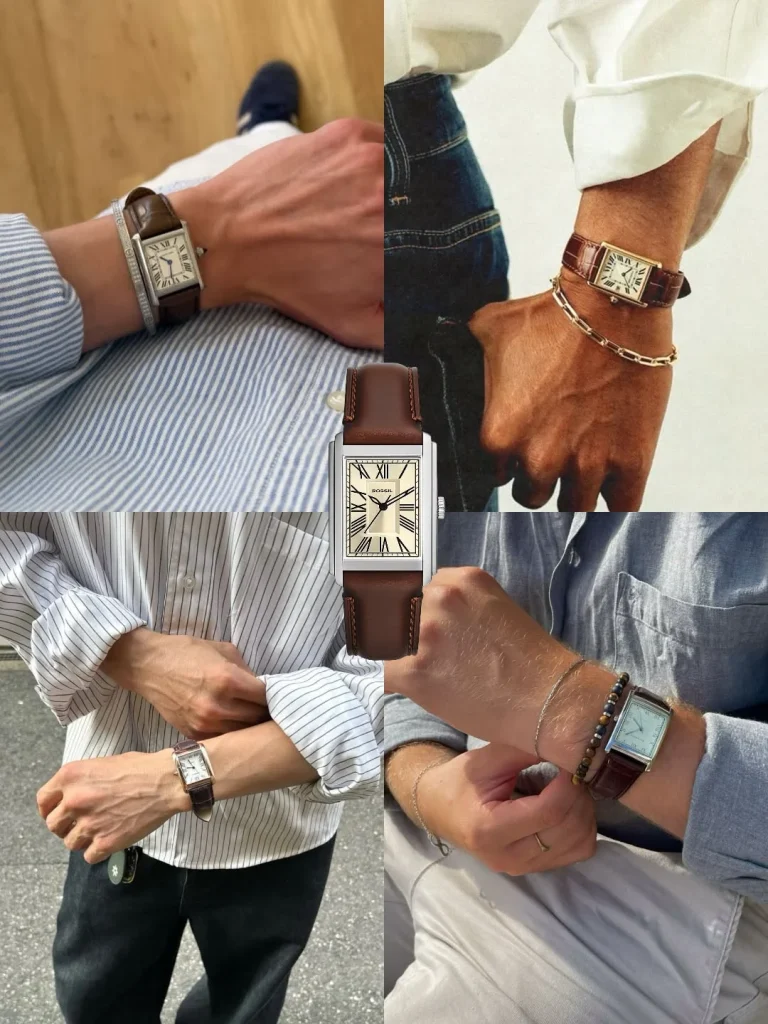
The Santos Cartier represents one of the most enduring designs in watchmaking history. Introduced over a century ago, this timepiece revolutionized wristwatches by prioritizing functionality and style. Its rectangular case, exposed screws, and bold numerals set it apart, influencing countless designs since. Today, enthusiasts appreciate its blend of aviation heritage and Art Deco elegance, making the Santos Cartier a benchmark for luxury watches.
What Inspired the Creation of the Santos Cartier?
The Santos Cartier originated from a practical need in the early 20th century. Aviation pioneer Alberto Santos-Dumont, a close friend of the designer, struggled to read pocket watches while flying. He requested a wristwatch that could be easily glanced at during flight. In response, the watchmaker crafted the first purpose-built pilot’s watch in 1904, debuting publicly in 1911. This collaboration birthed the Santos Cartier, marking a shift from pocket watches to wearable timepieces for active lifestyles.
Who Designed the Santos Cartier and When?
Louis Cartier, head of the family-owned firm, personally designed the Santos Cartier. Drawing from Santos-Dumont’s input, he created a square case with rounded corners, Roman numerals, and a distinctive blue cabochon crown. Patented in 1904, it was among the earliest men’s wristwatches produced in series. The design emphasized legibility with its clean dial and sword-shaped hands, features that remain hallmarks of the Santos Cartier today.
What Are the Key Design Features of the Santos Cartier?
The Santos Cartier stands out with its geometric case shape, typically 29mm by 41mm for smaller models, scaling up to larger variants. Eight exposed screws on the bezel secure the sapphire crystal, adding industrial appeal. The bracelet integrates seamlessly with the case via a patented system of links and screws, offering adjustable sizing. Roman numerals at key positions enhance readability, while options for complications like chronographs or annual calendars expand its versatility.
Internally, movements range from automatic calibers to high-end mechanical ones with column-wheel chronographs. Water resistance up to 100 meters suits everyday wear, and finishes include polished steel, yellow gold, or platinum. These elements combine form and function, defining the Santos Cartier’s timeless aesthetic.
How Has the Santos Cartier Evolved Over the Decades?
Since its debut, the Santos Cartier has undergone refinements while preserving core traits. In the 1970s, a medium-sized version with a quartz movement modernized it for the era. The 1980s saw slimmer profiles and gold executions, aligning with luxury trends. Revived in 1998 with a galvanized dial and updated bracelet, it gained renewed popularity.
Recent iterations introduce larger cases, skeletonized dials, and innovative materials like ceramic. The Santos Cartier now offers sizes from extra-large 39.8mm to petite 29.3mm, catering to diverse wrists. Complications have advanced to include dual time zones and flying tourbillons, yet the original spirit endures in every model.
What Materials and Movements Power the Santos Cartier?
Traditional Santos Cartier models use stainless steel for durability and affordability, with two-tone steel and gold for elegance. High-end versions feature 18-karat gold or platinum cases, often paired with leather straps or metal bracelets. Dials employ lacquered finishes in silver, blue, or anthracite, protected by scratch-resistant sapphire.
Modern examples house self-winding mechanical movements with 48-hour power reserves. Some integrate high-frequency chronometer-certified calibers for precision. The quick-change strap system allows effortless customization, enhancing practicality without compromising the Santos Cartier’s sophisticated profile.
Why Does the Santos Cartier Remain Popular Today?
The Santos Cartier’s appeal lies in its pioneering role as the first wristwatch for men, predating World War I aviation booms. Its Art Deco lines influenced mid-century design, and modern relaunches have attracted celebrities and collectors. Versatility across casual and formal settings broadens its reach.
Unlike round-dominant peers, its angular form offers unique wrist presence. Collectibility stems from limited editions and historical reissues, while everyday wearability ensures longevity. The Santos Cartier embodies innovation rooted in real-world utility, resonating in an era valuing heritage craftsmanship.
What Are Common Variations of the Santos Cartier?
Santos Cartier comes in multiple sizes: small for women or slim wrists, medium as the classic, large for bold statements, and extra-large for maximum impact. Strap options include steel bracelets, alligator leather, or rubber for sporty use. Skeleton versions reveal intricate mechanics, while gem-set dials add glamour.
Complication variants feature perpetual calendars, minute repeaters, or moon phases. Each maintains the signature screws and numerals, ensuring recognizability. This range allows personalization while honoring the Santos Cartier legacy.
Are There Any Limitations to the Santos Cartier Design?
Despite strengths, the Santos Cartier’s angular case may not suit all wrist shapes, potentially feeling bulky on smaller frames. The integrated bracelet limits modular strap changes compared to other styles. Higher-end models command premium prices due to materials and craftsmanship.
Maintenance requires professional servicing for complex movements, and its bold design might overwhelm minimalist preferences. However, these traits reinforce its niche as a statement piece rather than a universal daily wearer.
What Makes the Santos Cartier a Collector’s Favorite?
Collectors prize early 20th-century Santos Cartier originals for rarity, often fetching high auction values. Vintage 1980s quartz models offer accessible entry points. Modern limited editions with unique engravings or materials drive demand.
Its documented history, from patents to celebrity associations, adds provenance. Resale value holds strong due to consistent demand, making the Santos Cartier a smart long-term investment for enthusiasts.
In summary, the Santos Cartier endures as a milestone in horology, blending aviation origins with enduring style. Its evolution reflects changing tastes while staying true to foundational principles, ensuring relevance across generations.
People Also Ask
Is the Santos Cartier suitable for everyday wear?
Yes, its robust construction, water resistance, and comfortable bracelet make the Santos Cartier ideal for daily use, from office settings to weekend activities.
What sizes does the Santos Cartier come in?
The Santos Cartier is available in small (29mm), medium (35.1mm), large (39.8mm), and extra-large (47.5mm) case sizes to fit various preferences.
How does the Santos Cartier differ from other rectangular watches?
The Santos Cartier distinguishes itself with visible bezel screws, an integrated bracelet, and Roman numerals, rooted in its 1904 pilot-watch heritage.